
For as long as I can remember, one of our continual learning practices at Edoc Service, Inc. has
been reading a book together as a team, usually around once per year. These books have usually
been centered on business growth, leadership, culture, or the intersection of these themes.
In recent years, these books tend to be on how to become a better leader, how to strengthen your
culture even if you’re growing rapidly, and/or how to communicate more effectively…
This year, we chose a book centered on the topic of bravery, with the book The Bravery Effect by Jill Schulman.
Jill Schulman grew up in Minnesota and arrived at the University of San Diego at 18 on a U.S.
Marine Corps/NROTC scholarship. Looking back, Jill says she was unprepared for Marine
training, and how she really stood out as a woman. Jill says that on an early formation run
through the hills of Southern California, she discovered she wasn’t as fit as the others. At the
time, she questioned whether she belonged and whether she could “make it.”
Not only that, but just as this journey for her was beginning, a senior Marine candidate told her
she would never make it as a Marine Corps officer.
Pausing here… I think a lot of us can relate to this situation… it is one thing to wrestle with our
own self-doubt, and it’s another when someone else gives us a reason to believe that doubt.
But these factors (and others!) didn’t stop Jill. By her senior year, she was leading her NROTC
battalion of roughly 200 students. She completed Officer Candidate School and went on to
become a U.S. Marine Corps officer… and, I might add, was one of the first women to serve as
an officer in combat engineering.
Fast forward to today, and Jill has taken many experiences, like those in the Marine Corps and in
the business world, to help other leaders overcome the fear that limits their potential. Yes,
she has first-hand experience on the topic itself, but she also has studied the science behind the
concepts of resilience, human behavior, and why some people take action and why others don’t,
earning a Master’s in Applied Positive Psychology from the University of Pennsylvania. She
specifically pursued the degree because she wanted to better understand the science behind
resilience, human behavior, and why some people take action in the face of fear, while others
hold back.
Today, as an expert in the science of bravery, she regularly speaks with Fortune 500
organizations to help them operationalize bravery as a competitive advantage.
You can understand why we were also interested in reading the book and having her join us for
one of our study sessions.
What We Learned About Bravery
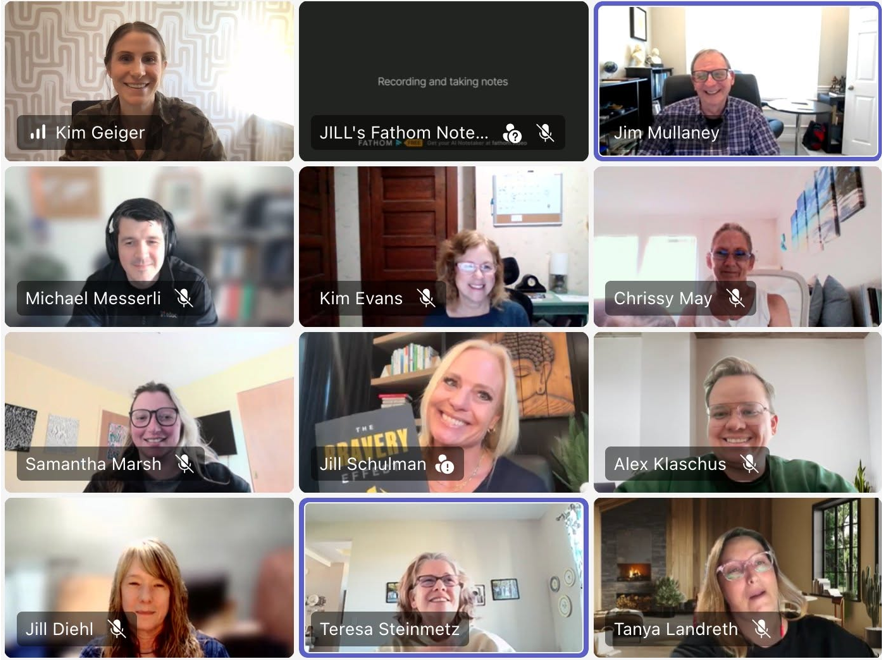
As we read the book, we had the privilege of having Jill join us for a deep dive and Q&A.
One of our favorite takeaways from our time with Jill and from reading her book is that the book
equips leaders to treat bravery as a skill and a habit, rather than a personality trait. Prior to
reading the book, many of us had perceived the idea of bravery as something you had, or didn’t
have!
The reality is growth tends to require discomfort—plain and simple. Repeatedly choosing
comfort and safety can keep us stuck, and that’s both on the professional side, as well as the
personal side.
Bravery, in contrast, is a muscle, and it can built, and it can often be found in small,
everyday choices to embrace the discomfort.
Other key takeaways our team had from our book study with Jill included:
- Bravery is often thought about as some large, courageous act. It can be that, but more
often, bravery is built in our small decisions, or in repeatedly choosing the
uncomfortable (or the right) thing. - Mindset comes first when it comes to building your bravery muscle. We often
have to rewire ourselves in terms of how we think. How we frame a challenge will
change what we believe is possible, or not possible. - The power of “yet” is important, in all aspects of our lives. There’s a big difference
between saying, “I’m not good at this…” and “I’m not good at this yet.” That one little
word shifts our mindset from seeing our abilities as fixed, to recognizing that we can
learn, grow, and get better. - Courage is so vitally important in our relationships. It could be the gift of feedback or
a difficult conversation you’ve been putting off. It could even be for asking for help or
admitting you were wrong.
All in all, we left our book discussion feeling inspired, learning more about one another, and
knowing that we can’t simply wait around to be bold or brave; It’s something we have to train
for, and then keep training for.
Over to You
I’d love to hear what’s working for you and your team when it comes to a culture of growth.
Have you read any books together as a team? After all, what better way to learn about continual
learning than to learn from one another…